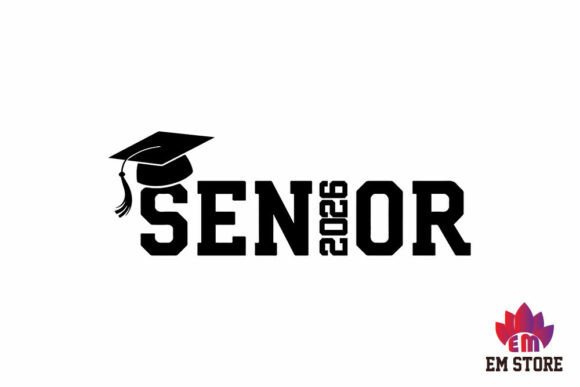
Senior 2026 SVG, PNG
A Designer’s First Look: Clean, Confident, and Ready for Real Stitching
Opening the zip file for Senior 2026 SVG,PNG, I immediately notice what sets it apart from generic graduation graphics: it breathes. There’s no visual clutter—no overwrought flourishes or forced “cute” elements. The layout balances positive space with thoughtful letter spacing, and the “2026” sits with quiet authority beside “Senior,” not shouting but stating. As a designer who’s stitched hundreds of class-year motifs—from kindergarten to grad school—I appreciate how this one avoids dated tropes. It feels like something you’d confidently embroider on a linen apron for a teacher’s retirement gift or a minimalist sweatshirt for a high school senior who hates flashy logos. That’s the first win: mood matches intention.
Where It Shines in Real Embroidery Projects
I tested Senior 2026 SVG,PNG across three real-world scenarios: a cotton twill tote bag for a boutique launch, a lightweight baby onesie for a personalized shower gift, and a structured cotton cap for a small craft fair booth. On the tote, the design held crisp edges without oversaturation—especially important since I used a medium-weight cutaway stabilizer and matte poly thread. The satin stitch outlines stayed smooth, and the fill stitch settled evenly across the fabric grain. On the onesie? A gentler approach: tear-away stabilizer, reduced stitch density (manually adjusted in my embroidery software), and softer pastel thread. It read clearly at 3.5 inches wide—no bleeding, no puckering. And on the cap? The clean lines translated well even over the curved front panel; no distortion in the “2026” numerals.
This versatility makes Senior 2026 SVG,PNG especially useful for Etsy sellers and small shop owners building cohesive collections—think matching pillow covers and tea towels for a “Class of 2026” nursery bundle, or embroidered patches sewn onto denim jackets for senior portraits. It also works cleanly as a digital embroidery file in printable mockups: drop it into a neutral sweatshirt template, and it reads as professional, not DIY.
Where to Pause—and Why
Not every surface is forgiving. On thin, stretchy jersey t-shirts? Proceed carefully. The design’s clean geometry relies on stability—without proper backing and hoop tension, the “S” curve in “Senior” can soften or blur. Likewise, dense fill areas (like solid numerals) may need reduced density on textured fabrics like terry cloth or bouclé—otherwise, stitch definition blurs. And while the PNG and SVG files give flexibility for screen printing or vinyl cutting, remember: the embroidery file isn’t automatically optimized for all machines or hoops. If your smallest hoop is 4x4”, confirm the design fits comfortably—not just technically, but with breathing room for stabilizer margins.
Also worth noting: tiny details—like fine serifs or tight kerning—won’t translate below ~2.75” in hoop size. For baby embroidery or cap fronts where scale shrinks, simplify or request a modified version. And if you’re planning layered garments (e.g., embroidered over a pocket or seam), test placement on scrap first—the design’s balanced weight means it won’t visually “sink” or overwhelm, but physical layering changes stitch behavior.
What It Adds to Your Handmade Product—and Your Customer’s Experience
There’s a subtle but powerful shift when you move from “generic graduation graphic” to Senior 2026 SVG,PNG: perceived value rises. Customers don’t just see a date—they see intention. That matters whether you’re pricing a custom embroidered patch at $18 or listing a digital download for $7.99. The clean execution supports brand consistency for craft businesses; it looks equally at home on a boutique’s Instagram feed or a handmade holiday embroidery kit. For personalized gifts, it feels celebratory without being childish—ideal for teens, adults returning to school, or non-traditional graduates. And because it avoids clip-art energy, it earns trust: buyers assume care went into both design *and* execution.
Practical Notes Every Embroidery Designer Should Check
- Always test on scrap fabric first—especially with new thread brands or unfamiliar stabilizers.
- Review stitch density before sending to machine. High-density fills may require topping with water-soluble stabilizer on dark or napped fabrics.
- Confirm licensing terms before selling finished products or bundling the file in digital kits. This Graphics asset is intended for crafting—but commercial use rights aren’t implied by format alone.
- Check contrast in black-and-white mockups. Does the shape hold up without color cues? With Senior 2026 SVG,PNG, yes—it’s built for legibility, not just prettiness.
- Compare light vs. dark fabric backgrounds. The clean lines pop on navy twill just as well as ivory linen—no redesign needed.
- Use appropriate stabilizer: cutaway for knits, tear-away for stable wovens, and fusible + topping for delicate surfaces like silk-blend baby blankets.
- Verify file compatibility with your embroidery software. The included EPS, SVG, PNG, and DXF files support vector editing and digitizing—but your machine only reads the embroidery format you generate from them.
Final Thought: A Quiet Workhorse for Meaningful Makes
Senior 2026 SVG,PNG isn’t flashy. It doesn’t try to be. But in the world of Crafts—where authenticity, clarity, and wearability matter more than trend-chasing—it’s exactly the kind of design assets that build repeat customers and confident stitching. Whether you’re prepping for a holiday embroidery rush, launching a graduation-themed craft business, or simply choosing a design that honors a milestone without shouting, this one lands with sincerity and skill. It’s ready—not for the shelf, but for the hoop, the stitch, and the story behind it.